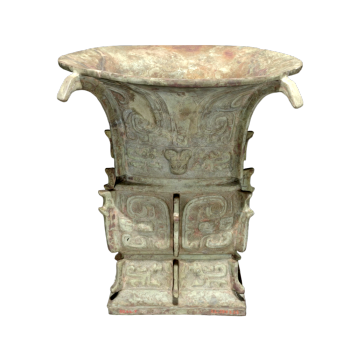
Shang Dynasty Bronze Gong Wine Ware

Shang Dynasty Bronze Gong Wine Ware

It's a ritual used to hold wine. It was mainly made during the reign of King Wu and King Zhao in the late Shang Dynasty (1300-1046 BC), and during the early Western Zhou Dynasty (1046-977 BC). Found in Anyang, this deep, boat-shaped wine-tipper demonstrates almost perfect craftsmanship. On the lower part of the handle and side are carved Taotie masks.
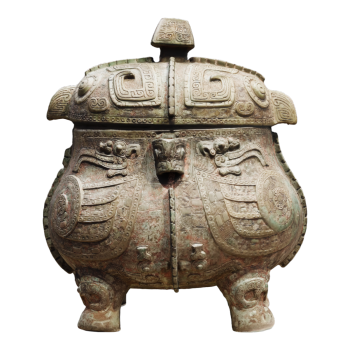
Western Zhou tripod

Western Zhou tripod

This relic is a tripod, a bronze vessel, and its ceramic prototype can be traced back to the Neolithic Peiligang culture. In the early Shang Dynasty (1600-1300 BC), bronze versions of the Pingzu Ding were cast. Ding is an ancient Chinese cooking or storage vessel, usually with two handles at the edge, supported by three or four columnar legs. The shape of the tripod is almost ubiquitous in China's early eras, including Neolithic ceramic vessels and Shang dynasty bronze vessels, as well as many later bronze and glazed pottery imitations. This artifact is in the collection of the Minneapolis Museum of Art.
Big Mouth Water Bottle (Cultural Relic of Haihun Marquis Tomb)

Big Mouth Water Bottle (Cultural Relic of Haihun Marquis Tomb)

The Haihun Marquis Tomb is located in Guanxi Village, Datang Ping Township, Xinjian District, Nanchang City, Jiangxi Province. It is the tomb of Liu He, the Haihun Marquis of the Western Han Dynasty. It is the best preserved, structurally complete, functionally laid out, and has the most complete sacrificial system of the Western Han Dynasty marquis cemetery in China so far. It is also the largest known area, rich in connotation, and relatively well preserved tomb of Han Dynasty local marquis levels in southern China. More than 10000 pieces (sets) of precious cultural relics such as gold, bronze, iron, jade, lacquered wood, bamboo slips, and wooden slips showcase the dream and glory of the Haihun civilization.
Tiger Phoenix Frame Hanging Drum

Tiger Phoenix Frame Hanging Drum

Cultural relics of Hubei Provincial Museum. Tiger Phoenix Hanging Drum, also known as Tiger Phoenix Hanging Drum or Tiger Bird Hanging Drum. Excavated from Tomb No. 2 of the Warring States Chu Dynasty in Jiuliandun, Hubei, it is a typical representative artifact of Chu musical instruments. This is one of the largest tiger shaped phoenix frame drums excavated from a Chu tomb in China. Its height is about 1 meter, with symmetrically arranged double phoenixes and double tigers as the drum frame. The base consists of two crouching tigers with their backs facing each other, with a phoenix standing on each tiger's back. The overall shape of the work is unique and elegant, with exquisite design, reflecting the designer's brilliant imagination and superb artistic expression, and possessing strong Chu cultural characteristics.
Minneapolis Institute of the Arts Clay Ceramic Tianma
Minneapolis Institute of the Arts Clay Ceramic Tianma

In the Eastern Han Dynasty from the 1st to the 3rd century AD, Chinese ceramic art reached a high level, and one representative work is the ceramic heavenly horse. It is an exquisite ceramic artifact that vividly depicts a galloping horse. It is usually made of fine clay and crafted through meticulous sculpture and painting techniques. The shape of Tianma is lifelike, sculpted according to the actual form and movement of the horse, expressing elegance, freedom, and a sense of power. Its smooth lines, graceful posture, and lifelike details showcase the ceramic artist's superb skills and observation of horses.
Chinese antique bronze wine vessel owl jar

Chinese antique bronze wine vessel owl jar

Chinese antique bronze wine pot

Chinese antique bronze wine pot

Chinese sacrificial wine vessels bronze square Yi

Chinese sacrificial wine vessels bronze square Yi

Antique Chinese copper square teapots and wine vessels from the Eastern Zhou Dynasty

Antique Chinese copper square teapots and wine vessels from the Eastern Zhou Dynasty

The Chu musical instrument "Tiger Seat Phoenix Frame Hanging Drum" from the Warring States period

The Chu musical instrument "Tiger Seat Phoenix Frame Hanging Drum" from the Warring States period

Tiger Phoenix Frame Hanging Drum, also known as Tiger Phoenix Frame Hanging Drum or Tiger Bird Frame Drum. Excavated from Tomb No. 2 of the Warring States Chu Dynasty in Jiuliandun, Hubei, it is a typical representative artifact of Chu musical instruments. This is one of the largest tiger shaped phoenix frame drums excavated from a Chu tomb in China. Its height is about 1 meter, with symmetrically arranged double phoenixes and double tigers as the drum frame. The base consists of two crouching tigers with their backs facing each other, with a phoenix standing on each tiger's back. The Tiger Seat Phoenix Frame Hanging Drum was an important type of musical instrument in the Chu state during the Warring States period. It is a lacquerware from the Eastern Zhou Dynasty, unearthed from Tomb No. 2 of Jiuliandun in Zaoyang City, Hubei Province. It is an exquisite handicraft that combines lacquer, carving, and painting techniques organically.
Changsha Kiln Lion Candlestick "created by Hu Wuqiang

Changsha Kiln Lion Candlestick "created by Hu Wuqiang

The Tang Dynasty Changsha kiln blue glazed brown green colored lion shaped candle holder has a height of 13.2 centimeters, a diameter of 2.2 centimeters, and a base diameter of 9.8 centimeters. The device is in the shape of a sheep, with vertical ears, closed mouth, rolled tail, and a horizontal view. Carrying a cylindrical candle tube, crouching on the carved throne with bent limbs. Round seat, flat bottom. The front, left, and right sides of the abdomen each have pointed leaf shaped doors, which resemble the shape of a lion. The tire is gray and white in color, with light brown green stripes on the body and a light yellow green glaze on the outer cover. The device has a stable shape, a gentle and cute animal image, and colorful glaze decoration. Early celadon candle holders were mostly shaped like animals. During the Three Kingdoms period, there were also sheep shaped candlesticks.
Shang Dynasty Sanxingdui bronze ware "Shang Bronze Man Head"
Shang Dynasty Sanxingdui bronze ware "Shang Bronze Man Head"

This cultural relic is a bronze ware from the Shang Dynasty, with a human head of Fang Yi. It comes in two types: flat topped and round topped, with large or vertical ears and perforated earlobes. Garlic nose, wide mouth, and thick neck. Wrap the hair backwards and add braids or hair accessories to the back of the head. It is currently collected in the Sanxingdui Museum.
Qing Dynasty Qianlong period vase "Carving Peacock Stone Vase"

Qing Dynasty Qianlong period vase "Carving Peacock Stone Vase"

The Qianlong seal is located within the square border on the bottom. In the form of a water basin decorated with character patterns and dragons, surrounded by flower branches.
Late Shang Dynasty marble sculpture "Double sided bird faced tube of marble carving"

Late Shang Dynasty marble sculpture "Double sided bird faced tube of marble carving"

This pole decoration with two owl heads is the same as R005055. The owl faces on opposite sides are identical and separated by carved lines. The shape of the head is a top heavy, top light trapezoid. The curved beak of an owl is presented in deep relief and decorated with raised lines and jagged edges. The owl's horns, ears, and chin are depicted in low relief. The owl has eyes engraved in the shape of "chen". The top and bottom of the cultural relic are not decorated, with a diamond shaped top and an oval shaped bottom. Passing through the middle of the artifact is a tubular hole with parallel grinding tool marks on its inner wall, and it is suspected that the hole was created using tubular drilling technology.
The Tang Dynasty musical instrument "Five stringed Pipa"

The Tang Dynasty musical instrument "Five stringed Pipa"

The pipa originated in China and is generally a four stringed instrument. The five stringed instrument is specifically called the five stringed instrument. The "Book of Rites and Music" in the Old Book of Tang states: "The pipa, five stringed instrument, and Kabuki have been loved since Wenxiang, and have been particularly popular since the Heqing period." The five stringed pipa was a plucked string instrument played by a few ethnic groups in northern China in ancient times. Abbreviated as Wuxian. With a long history and unique design, it was popular in the vast Central Plains region of China during the Tang Dynasty and spread eastward to Japan, becoming a historical witness to cultural exchanges between China and Japan.
Bronze ware from the Zhou Dynasty, "Zhou Dynasty Food Utensils - Tripod"

Bronze ware from the Zhou Dynasty, "Zhou Dynasty Food Utensils - Tripod"

The tripod is regarded as a symbol of national importance, power, and prestige. The character "tripod" is also endowed with extended meanings such as "distinguished", "noble", and "grand", such as "one word nine tripods", "famous name", "peak period", "strong assistance", and so on. It is also a ceremonial vessel for recording achievements. During major celebrations or receiving rewards, the rulers or nobles of the Zhou Dynasty would cast cauldrons to record the grand occasion. This kind of etiquette still has a certain influence today.
Ceramic "Three Colored Double Dragon Zun" from the Tang Dynasty

Ceramic "Three Colored Double Dragon Zun" from the Tang Dynasty

This statue is a vessel used by Tang Dynasty nobles to serve alcoholic beverages. The authentic product was created during the prosperous Tang Dynasty and was unearthed from a Tang tomb in Luoyang. It has now been circulated among the people. The upper half of the statue is glazed with yellow, green, and white spots, while the lower half is plain. Pankou, neck tied, round shoulder, bulging belly, flat bottom, with symmetrical double dragon handles carved between the shoulder and the mouth, symbolizing "two dragons playing in the water". The shape is full and vivid. This exhibit is currently housed in the Luoyang Tang Sancai Ceramics Museum. First stored in the Tang Sancai Ceramics Museum in Luoyang.
Ceramic Tile at the Top of the White Tower at Zhakou during the Song Dynasty

Ceramic Tile at the Top of the White Tower at Zhakou during the Song Dynasty

The Zhakou White Pagoda is entirely carved and built with white stone, and is a carved tower in the style of a wooden tower. At the bottom of the tower is the pedestal, carved with patterns such as mountain peaks and waves, symbolizing the "Nine Mountains and Eight Seas", with a Sumeru pedestal standing on top. The waist of the tower seat is engraved with Buddhist scriptures, and the tower body is decorated with reliefs of Buddha, Bodhisattva, and stories of sutras, with vivid character images. The Zhakou White Pagoda is a typical example of a wooden tower architecture from the late Northern Song Dynasty, and therefore has high research value.
The Bronze Statue of Zhou Dynasty's Respectful Posture

The Bronze Statue of Zhou Dynasty's Respectful Posture

This small and delicate figure stood with outstretched arms in a respectful posture. His curled fingers formed a socket that could grip the handle of the oil lamp. The character is wearing a long waistcoat with a regular waistband fixed by a belt hook around their waist. Throughout the entire Shang and Western Zhou dynasties (1600-771 BC), bronze figures were rare, but now several bronze figures have been unearthed from tombs of the Warring States period in the late Zhou dynasty as lamp posts. The strong sculptural quality of this character foreshadows the naturalism encountered in the subsequent Qin (221-206 BC) and Western Han (206-25 BC) eras.
Bronze ware from the Shang Dynasty, "Wine Vessel Gu"

Bronze ware from the Shang Dynasty, "Wine Vessel Gu"

This wine vessel is currently housed in the Minneapolis Museum of Art in the United States. Gu wine vessel is a tall and elegant wine glass with a compact shape, with a trumpet shaped top, gradually narrowing in the middle, and slightly expanding outward at the bottom. Archaeological evidence shows that bronze wine vessels first appeared during the Erligang Culture period of the Shang Dynasty (1500-1300 BC). Gu wine vessels were most popular during the Shang Dynasty (1600-1046 BC), but became relatively rare in the early Western Zhou Dynasty (1046-977 BC) and gradually disappeared during the Eastern Zhou Dynasty (770-256 BC).
7th century Tang Dynasty gilded bronze sculpture "A Pair of Xianglong - Left"

7th century Tang Dynasty gilded bronze sculpture "A Pair of Xianglong - Left"

This Chinese cultural relic is named "A Pair of Xianglong" and was made during the Tang Dynasty in the 7th century. It is made of gold-plated bronze. The dragon is a universal symbol of glory in Chinese culture. As early as the Neolithic Age, the Chinese believed that this mythical creature was an auspicious animal, living in heaven, providing rain and nourishing life. In the late Bronze Age, dragons were equated with emperors. In 221 BC, the great unifier of China and builder of the Great Wall, Qin Shi Huang, declared himself a descendant of dragons. Since then, almost every ruler has been referred to as the "True Dragon Emperor", and the Chinese court is known as the Dragon King constellation, with the official court attire being dragon robes.
The ceramic "Fengxiang Pink Porcelain" from the Jiaqing period of the Qing Dynasty

The ceramic "Fengxiang Pink Porcelain" from the Jiaqing period of the Qing Dynasty

This Chinese cultural relic is a porcelain vase from the Jiaqing period of the Qing Dynasty (1796-1820). The vase is made of transparent and colorless underglaze powder colored porcelain, fired in Jingdezhen, and is now collected in the Patna Museum of Art and History.
During the Kaiyuan period of the Tang Dynasty, the ceramic "Tang Dynasty Cobalt Pottery Jar"

During the Kaiyuan period of the Tang Dynasty, the ceramic "Tang Dynasty Cobalt Pottery Jar"

Tang Dynasty cobalt pottery jars are a very rare type of pottery, characterized by the use of cobalt blue glaze. In the Tang Dynasty, cobalt blue glaze was very popular, but due to the high price of high-quality cobalt ore, it was usually only used sparingly. Chinese cobalt ore contains manganese, so its color tends to be darker. The glaze of the jar flows during the firing process, so it stops before the feet, which is a characteristic of Tang Dynasty lead glazed pottery. It is currently housed in the China Ceramic Museum.
Sandstone sculpture from the Northern Wei Dynasty titled 'Stone Statue of Buddha Sitting in Four Sided Shrine'

Sandstone sculpture from the Northern Wei Dynasty titled 'Stone Statue of Buddha Sitting in Four Sided Shrine'

This Chinese cultural relic is a seated Buddha statue in a four sided shrine, made during the Northern Wei Dynasty and carved from sandstone. Unearthed in 1957 in Nanguoshui, Qin County, with severe weathering on the surface, it is collected by the Nanguoshui Stone Carving Museum in Qin County. A total of 4 niches were unearthed, each engraved with 4 Buddha statues.